The average IQ is 100. On the scale most commonly used today, around 68% of the normative sample scores between 85 and 115. An IQ score therefore shows primarily how a test result compares with those of other people. It does not measure how much “intelligence” a person possesses.
What is the average IQ?
The short answer is 100. This value is not obtained by collecting arbitrary IQ results and calculating their average afterwards. Instead, it is defined as the centre of the scale when the test is standardised.
To do this, a sufficiently large and appropriate comparison group completes the test. The raw scores—for example, the number of correctly answered questions—are then converted into standard scores. An IQ of 100 represents performance at the centre of this comparison group. A score above 100 is above its mean, while a score below 100 is below it. Without an appropriate normative sample, a raw score would be difficult to interpret meaningfully.[1]
IQ is therefore not a unit of measurement like centimetres or kilograms. It is a standardised comparison score. Its meaning comes from comparing a person’s performance with that of other people under defined conditions.
What IQ is considered normal?
People often ask what counts as a “normal IQ”. Statistically, it is more accurate to speak of a common range or a range close to the average. On a scale with a mean of 100 and a standard deviation of 15, about two thirds of the normative sample score between 85 and 115.
However, 85 and 115 are not hard boundaries separating “normal” from “not normal”. A score of 84 should not suddenly be interpreted as fundamentally different from a score of 85. Every test score also involves some degree of measurement uncertainty. Categories can be useful for orientation, but they should not imply more precision than the test can actually provide.
“Normal” is not a judgement of a person
An IQ score describes selected cognitive abilities demonstrated in a testing situation. It says nothing about a person’s worth and does not fully capture personality, life experience, motivation, or social skills.
IQ scores and percentile ranks at a glance
A percentile rank is often easier to understand than the IQ score itself. It indicates the percentage of people in the normative sample who achieved the same score or a lower score. An IQ of 115, for example, corresponds approximately to the 84th percentile. This means that around 84% of the comparison group scored at or below this level.
| IQ score | Distance from the mean | Approximate percentile rank | Interpretation |
|---|---|---|---|
| 70 | −2 standard deviations | 2.3 | About 2.3% score at this level or below. |
| 85 | −1 standard deviation | 15.9 | Lower boundary of the common range from 85 to 115. |
| 100 | Mean | 50.0 | Half of the normative sample scores below this value and half above it. |
| 115 | +1 standard deviation | 84.1 | Upper boundary of the common range from 85 to 115. |
| 130 | +2 standard deviations | 97.7 | About 2.3% achieve the same score or higher. |
| 145 | +3 standard deviations | 99.9 | A statistically very rare result. |
These values are calculated from an idealised normal distribution with a mean of 100 and a standard deviation of 15, then rounded. Estimates are generally less certain at the extreme ends of a scale. Test manuals may also use different labels for score ranges.
Why IQ scores follow a bell curve
The conventional IQ scale is based on the normal distribution, also known as the Gaussian distribution. It forms a bell-shaped curve: most scores lie close to the mean of 100, and scores become less common the further they are from that point. The SON-R 6-40, an established non-verbal intelligence test available in German, for example, reports its overall IQ on a scale with a mean of 100 and a standard deviation of 15.[2]
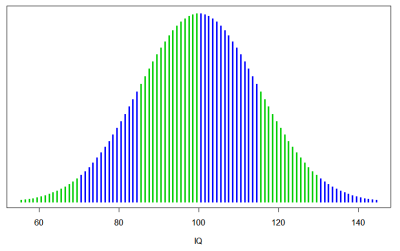
The standard deviation describes how widely scores are spread around the mean. On the most commonly used IQ scale, one standard deviation corresponds to 15 points:
- IQ 85 is one standard deviation below the mean.
- IQ 115 is one standard deviation above the mean.
- IQ 70 and IQ 130 are each two standard deviations from the mean.
The difference between IQ 100 and IQ 115 is 15 points, just like the difference between IQ 130 and IQ 145. Yet these ranges contain very different proportions of the population: many people score close to the mean, while very few score at the extremes of the distribution.
How is an IQ score calculated?
The term “intelligence quotient” comes from a time when a child’s so-called mental age was divided by their chronological age. Modern IQ tests no longer usually calculate scores in this way.
Today, the first step is to evaluate how a person performed on the questions or subtests. This raw result—for example, the number of correctly answered questions—is not an IQ score by itself. What matters is where that performance falls within an appropriate comparison group.
This position is then mapped onto the familiar IQ scale. Performance exactly at the centre corresponds to an IQ of 100. A person who performs better than approximately 84% of the comparison group has an IQ of about 115. A result within roughly the top 2% corresponds to an IQ of around 130.
The bell curve therefore does not show how many questions someone must answer correctly. It describes how frequently results occur within the comparison group. There is no universal formula that converts, for example, 30 correct answers into the same IQ score on every test. Questions, difficulty levels, and scoring methods differ from one test to another.
Does average IQ depend on age?
Modern intelligence tests normally compare a person with others in an appropriate age group. The mean is therefore approximately 100 in every normed age group. A 20-year-old and a 60-year-old with an IQ of 115 both score a similar distance above the average of their respective comparison groups.
This does not mean that every cognitive ability remains equally strong at every age. Processing speed, memory, vocabulary, and reasoning may develop differently across the lifespan. Age-based norms prevent these changes from automatically creating an unfair comparison between younger and older adults.
It is therefore important that a test is designed for the test taker’s age and uses suitable, preferably up-to-date norms. A test intended for adults cannot simply be applied to children, or vice versa.
What is the average IQ in Germany?
In an IQ test normed for Germany or the wider German-speaking population, the mean of the normative sample is also 100. This is how the scale is defined during the standardisation process.
The statement “the average IQ in Germany is 100” is therefore primarily a statement about the norm scale being used. It does not mean that any arbitrary group of German internet users will achieve a mean of exactly 100 on every test. Voluntary online samples often differ from the overall population—for example, in age, education, motivation, or familiarity with this type of task.
International rankings that claim to compare the average IQ of different countries are even more difficult to interpret. Tests, languages, samples, years of data collection, and living conditions may differ considerably. When interpreting an individual result, the normative sample of the specific test is more relevant than a table of countries. The International Test Commission likewise emphasises that linguistic, cultural, and social context must be considered when adapting, administering, and interpreting tests.[3]
What does an IQ test measure—and what does it not measure?
In psychology, intelligence is not a single object that can be observed directly. Instead, it is inferred from performance on carefully selected tasks. Research and test theories distinguish between several related cognitive abilities. Depending on the test, these may include reasoning, verbal comprehension, working memory, processing speed, and spatial reasoning. The Cattell-Horn-Carroll model, or CHC model, is an important framework for organising these broad and more specific abilities.[4]
A full-scale IQ score combines performance across several tasks into a single, readily comparable figure. This is useful, but it inevitably compresses information. Two people with the same overall score may have different strengths and weaknesses in particular areas.
Even an excellent intelligence test does not measure the whole person. The following, for example, are either not captured or captured only to a limited extent:
- personality, interests, and values;
- perseverance, self-discipline, and everyday motivation;
- creativity in its full range;
- social experience and practical judgement;
- knowledge and abilities not represented in the test questions.
IQ tests nevertheless measure important cognitive differences and, when used appropriately, can provide valuable information. However, a test must be suitable for the purpose for which it is used, and its result should not be mistaken for a complete description of intelligence or personality.[5]
How precise is an individual IQ score?
An IQ result is often presented as a single number. From a professional perspective, however, that number is an estimate. If the same person completed several equivalent forms of a test under comparable conditions, the results would probably not be identical every time.
Possible influences include the selection of questions, concentration, motivation, fatigue, interruptions during testing, and previous familiarity with similar tasks. The Standards for Educational and Psychological Testing explicitly note that performance can vary from one measurement to another, even under controlled conditions.[6]
Professional test reports therefore often provide a confidence interval. Instead of treating an IQ of 118 as a perfectly exact figure, they report a range within which the underlying score is estimated to fall with a specified level of statistical confidence. The width of that interval depends on the test and its measurement precision. Without the psychometric data for the specific instrument, no single general interval can be stated responsibly.
Especially important near cut-off scores
If a result lies close to a threshold—for example, during an assessment for giftedness or special educational support—a single point score should never be considered in isolation. Measurement uncertainty, the person’s profile across subtests, testing conditions, and other information all form part of a professional evaluation.
Online IQ test or professional assessment?
A well-designed online IQ test can provide a useful estimate and show how your performance on its questions compares with the reference data used for scoring. It is particularly suitable if you are curious and looking for an initial indication.
A professional psychological assessment goes further. A qualified professional selects an instrument suited to the specific question, ensures standardised conditions, observes the testing process, and considers the profile of individual abilities as well as the overall score. The results can also be evaluated alongside an interview, personal history, and other diagnostic information.
A professional assessment is particularly appropriate when important decisions depend on the result—for example, educational support, school-related questions, clinical concerns, or a formal assessment of giftedness. An online IQ test cannot replace this process.
In the article “Free IQ Test with Certificate: How Reliable Is It?”, I explain in detail how our test was developed, which data we use for scoring, and where we see its limitations.
My conclusion: A useful number when interpreted correctly
What interests me about IQ is not only the number at the end of a test. The ideas behind it are more revealing: comparison with a normative sample, the interaction between different cognitive abilities, and the question of how confidently a result can be interpreted.
An IQ of 100 represents the centre of the scale being used. A higher or lower score describes a statistical position—not a ranking of people’s worth. That is how I want results on IQ-Test.org to be understood: as interesting and as transparent as possible, but never as a final label.
Frequently asked questions about average IQ
What is the average IQ?
The average IQ is 100 on the scale most commonly used today. During standardisation, this value is defined as the mean of the comparison group.
What IQ is considered normal?
Around 68% of the normative sample scores between IQ 85 and 115. This common range is a statistical guide, not a hard boundary between “normal” and “not normal”.
What does an IQ of 130 mean?
An IQ of 130 is two standard deviations above the mean and corresponds approximately to the 98th percentile. Around 2.3% of the normative sample achieve the same score or higher. This score is often used as a reference point when defining giftedness, but it should be interpreted with measurement uncertainty in mind.
Does average IQ depend on age?
Modern IQ tests normally compare a person with an appropriate age group. The mean is therefore approximately 100 in different normed age groups, even though individual cognitive abilities can change across the lifespan.
Why can two IQ tests produce different results?
Tests may use different questions, normative samples, and scoring methods. Measurement uncertainty and testing conditions also play a role, so small differences between two results are not unusual.
Sources and further reading
- Wyschkon, A. (2019). Normwerte in Leistungstests: Prozentränge richtig interpretieren. Hogrefe. Open-access article in German
- Hogrefe Testzentrale. SON-R 6-40 – Non-verbaler Intelligenztest. Information on the scale used for the standardised overall score. Open-access test description in German
- International Test Commission (2005). ITC Guidelines for Translating and Adapting Tests. Open-access original document (PDF)
- McGrew, K. S. (2009). CHC theory and the human cognitive abilities project: Standing on the shoulders of the giants of psychometric intelligence research. Intelligence, 37(1), 1–10. DOI and publisher page
- Neisser, U. et al. (1996). Intelligence: Knowns and Unknowns. American Psychologist, 51(2), 77–101. DOI; open-access full text (Stellenbosch University, PDF)
- American Educational Research Association, American Psychological Association & National Council on Measurement in Education (2014). Standards for Educational and Psychological Testing. Open-access full text (PDF)
Transparency: This page is intended to help readers understand IQ scores. It does not provide an individual diagnosis. Since IQ-Test.org launched, more than 100,000 test submissions have been recorded. The current comparison database used for scoring contains more than 40,000 records that meet today's quality criteria. These data do not by themselves constitute clinical validation or diagnostic recognition.